
November 19, 2026
Engineered Wood Fiber vs Playground Wood Chips
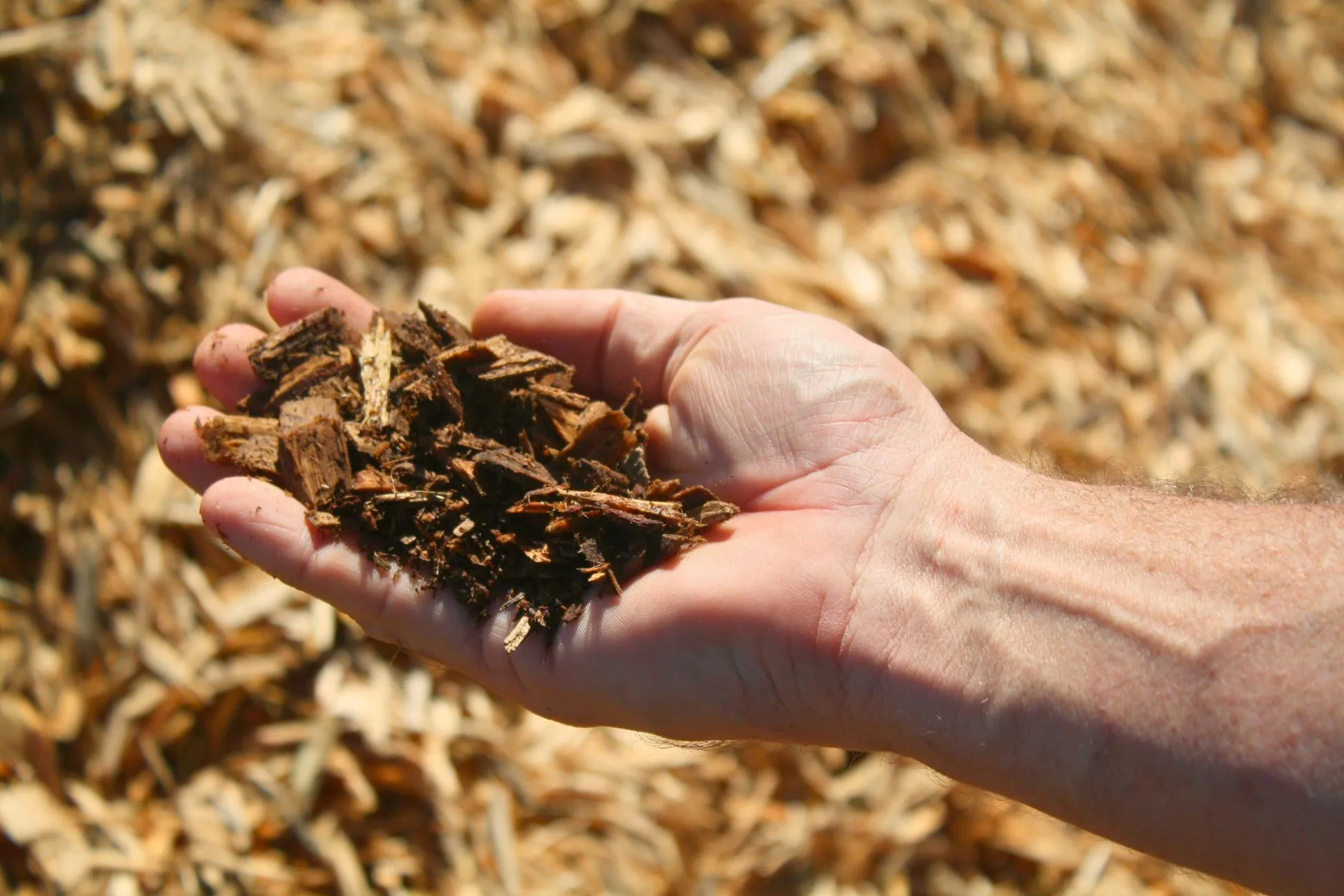
Engineered wood fiber vs playground wood chips comes down to testing. Engineered wood fiber (EWF) is clean wood processed to a controlled size to meet playground safety standards, and certified products are tested to prove it. Ordinary wood chips and landscape mulch aren’t made or tested for that job. For a school, park or accessible playground, choose certified fiber.
The names overlap, so check the certification, not the label: the IPEMA-certified playground chips from American Pole & Timber (APT) meet IPEMA’s standards for engineered wood fibers. APT’s engineered wood fiber is IPEMA certified, too.
Key Takeaways
- Certification is the difference. APT’s engineered wood fiber is IPEMA certified; ordinary chips come with no test results.
- Depth does the cushioning. APT recommends 12 inches after settling and compaction for most playgrounds.
- Access depends on the product and upkeep. Ask for an ASTM F1951 accessibility test report, and keep the surface level and at depth.
- Order by the cubic yard. APT’s calculator figures 1 cubic yard per 21 square feet at 12 inches deep.
What is the difference between engineered wood fiber and playground wood chips?
Engineered wood fiber is made to be a playground safety surface; ordinary wood chips are a landscaping product.
| Compare | Engineered wood fiber | Ordinary wood chips and mulch |
|---|---|---|
| What it is | Clean wood processed to a controlled size | Chipped trees, bark or wood waste |
| What’s in it | APT’s: 100% virgin wood, minimal bark, no twigs or leaf debris | Varies by load: bark, leaves, twigs, sometimes foreign material |
| Testing | Certified products, like APT’s, are tested to ASTM standards | No playground test results or certificate |
| Fall protection | Impact tested at a stated depth | Some cushioning, but no rating for your load |
| Wheelchair access | APT’s is firm enough for wheelchairs when kept level | Loose chips are hard to roll across |
| Best for | Parks, schools and private playgrounds | Planting beds and garden paths |
Which standards should playground wood fiber meet?
Look for IPEMA certification to the ASTM playground surfacing standards, plus an ASTM F1951 test for an accessible play area. APT’s engineered wood fiber is certified by the International Play Equipment Manufacturers Association (IPEMA), and its product page shows IPEMA seals for ASTM F1292, F2075 and F3351. APT’s playground chips page shows the same 3 seals and names F1292 and F2075. In general, they cover:
- ASTM F1292: impact attenuation, or how well the surface under and around playground equipment cushions a fall at a tested depth.
- ASTM F2075: the specification for engineered wood fiber as a playground safety surface, including particle size, tramp metal (stray bits of metal) and hazardous metals.
- ASTM F3351: a laboratory impact test of the surface at a specified test height.
Certification belongs to a specific product, so verify it: APT’s pages point buyers to ipema.org to search. A load of ordinary mulch has no certificate to look up.
Which is safer under playground equipment?
Certified fiber kept at the right depth is the more predictable choice, because its fall protection has been tested. Ordinary chips give some cushioning when deep, but the load you buy hasn’t been tested, and its size and content vary.
- Fall height: the height of the highest designated play surface, such as a deck or platform. The equipment maker can tell you what it is.
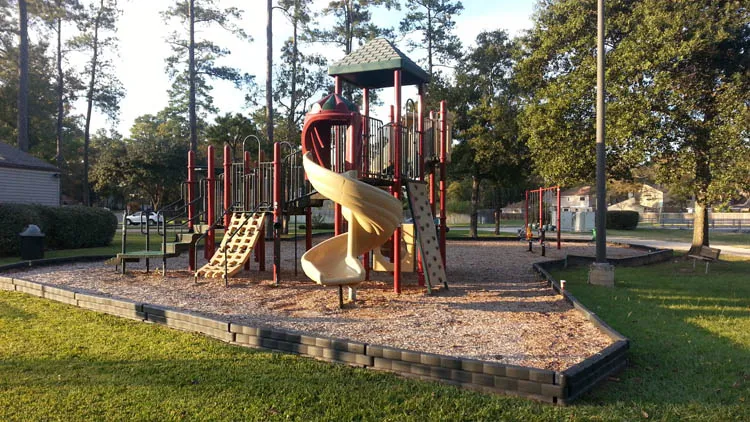
- Depth: APT recommends 12 inches after settling and compaction for most playgrounds. Fiber settles, so spread more: the engineered wood fiber installation and maintenance guide on APT’s product specifications page calls for about 16 inches loose to get 12 inches compacted.
- Coverage: the whole use zone around the equipment, with no thin spots.
The same guide says to keep the depth at whichever is greater: what the fall height requires or the surfacing maker’s recommended depth. For fall heights and use zones, follow the equipment maker’s instructions and the U.S. Consumer Product Safety Commission’s Public Playground Safety Handbook.
Is engineered wood fiber wheelchair accessible?
It can be, if it’s the right product and it’s maintained. APT’s engineered wood fiber gives a soft, springy surface to cushion falls, yet is strong enough for stroller and wheelchair use. It stays accessible only while it’s level, compacted and at depth.
- Ask for the accessibility test. The surface accessibility standard is ASTM F1951; the guide on APT’s specifications page recommends getting the manufacturer’s F1951 test report.
- Plan the way in: an accessible ramp, with the surface kept within 1/4 inch of the top of the border at entrances.
- Use wear mats with tapered edges under swings and at slide exits.
- Rake and top off high-traffic spots before ruts form.
What do they cost to buy and keep up?
APT quotes engineered wood fiber per project, because the price depends on how much you need and where it’s going. Ordinary mulch may cost less per yard, but it isn’t certified for playgrounds.
What drives the price
- Volume: area times depth, in cubic yards.
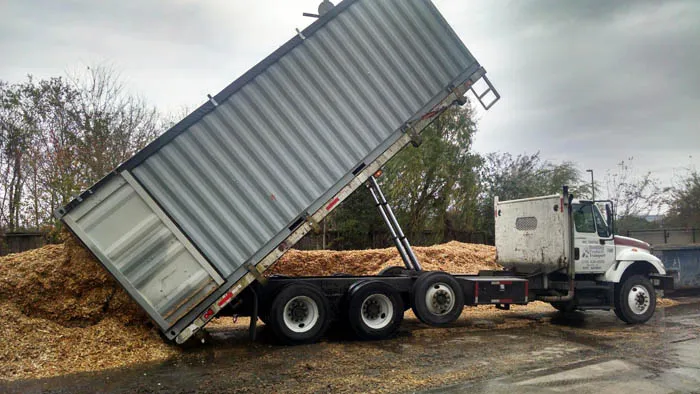
- Delivery: bulk orders of engineered wood fiber get cost-effective delivery; for playground chips, APT’s fleet trucks deliver 25 or 40 cubic yards per load within 120 miles of APT’s location.
- Site work: grading so the area drains, a border to hold the fiber, drainage where needed, and wear mats.
- Labor to spread and level it.
What upkeep looks like
- Weekly: rake fiber back under swings and slides, check the depth and remove debris.
- After rain: make sure water drains away. APT’s fiber lets rain pass through quickly.
- Top-offs: typically every 2 to 5 years, depending on climate and use, per the installation and maintenance guide.
How much engineered wood fiber do you need?
Measure the area, then use APT’s playground fiber calculator: it works out cubic yards for rectangles, circles or a known square footage, figuring 1 cubic yard for every 21 square feet at 12 inches deep. That’s more fiber than plain geometry gives (a cubic yard covers 27 square feet at exactly 12 inches), and APT’s recommended 12 inches is measured after settling.
Example: a 30-by-40-foot play area is 1,200 square feet; 1,200 ÷ 21 = 57.1, so order about 58 cubic yards. Measure the whole surfaced area, not just the equipment footprint, and round up. Want to see the material first? APT can mail samples of its playground chips on request.
Which should you choose?
Choose certified engineered wood fiber wherever you need a tested playground surface or wheelchair access; ordinary chips are made for landscaping.
- Parks, schools and public playgrounds: IPEMA-certified fiber, with certificates for your files.
- Accessible play areas: certified fiber with an F1951 report and a maintenance plan.
- Backyard play sets: certified fiber gives you a tested surface; if you use ordinary chips, keep them deep and clean.
- Dog parks and horse arenas: APT supplies engineered wood fiber for these, too.
- Animal bedding: see APT’s wood chips and shavings.
To price fiber for your site, call APT’s Project Consultants at 1 (800) 716-0636 or see APT’s IPEMA-certified engineered wood fiber.
Engineered wood fiber and playground chips FAQ
Is engineered wood fiber the same as wood chips?
No. Engineered wood fiber is clean wood processed to a controlled size for playground surfacing, and certified products are tested to the ASTM standards. Ordinary wood chips and mulch are landscaping products with no playground test results. Some certified fiber is sold as “playground chips,” so look for IPEMA certification, not the name.
Are wood chips safe for playgrounds?
Ordinary chips cushion somewhat when deep, but a given load comes with no test results or certificate, and its size and content vary. For public and school playgrounds, choose engineered wood fiber certified by IPEMA to ASTM F1292 and F2075, kept at the depth your equipment’s fall height requires. For an accessible play area, also ask for an ASTM F1951 test report.
How deep should engineered wood fiber be on a playground?
For most playgrounds, APT recommends 12 inches, measured after settling and compaction. Because fiber settles, the installation and maintenance guide on APT’s specifications page calls for spreading about 16 inches loose to end up with 12 inches compacted. The depth must also suit your equipment’s fall height, so check it often under swings and slides, where fiber gets kicked out.
Is engineered wood fiber ADA compliant?
It can be, but that depends on the product’s test results and on upkeep. The surface accessibility standard is ASTM F1951, so ask for the manufacturer’s F1951 test report. Keep the surface level and at depth, use wear mats with tapered edges, and provide an accessible ramp into the play area.
How long does engineered wood fiber last?
Plan on topping it off. The installation and maintenance guide on APT’s specifications page says top-offs are typically needed every 2 to 5 years, depending on climate and use. Fiber that stays waterlogged can break down and may need replacing, so good drainage helps it last.
How many square feet does a cubic yard of playground fiber cover?
APT’s playground calculator figures 1 cubic yard for every 21 square feet at 12 inches deep. For another depth, multiply the area by the depth in feet and divide by 21. For example, 1,200 square feet at 12 inches needs about 58 cubic yards.
How do I check that a product is IPEMA certified?
Search for it on IPEMA’s website, ipema.org. Certification belongs to a specific product, so check the exact product you’re buying. APT’s engineered wood fiber page shows IPEMA seals for ASTM F1292, F2075 and F3351 and points buyers to ipema.org to verify.
Can I get a sample of APT’s playground fiber?
Yes. APT can mail samples of its playground chips on request. Their color varies through the year, so you can also call ahead and stop by to see current stock. To ask for a sample or a quote, call APT’s Project Consultants at 1 (800) 716-0636.
Get a quote on engineered wood fiber
Use the form below or call 1 (800) 716-0636. Tell us the area and depth or the cubic yards you need, the use (playground, dog park or horse arena), your delivery ZIP code and your timeline, and an APT Project Consultant will reply with a quote.
Posted in News & Articles, Products
Massive Selection. Custom Production. We Get Your Project Moving Fast.
Ready to start your pole & timber project?