
Salt-killed wood pilings: The problem treatment can’t fix

Salt-killed wood pilings are one of the most misunderstood failures on the Texas coast. The surface looks fuzzy and broken down, so people assume it is rot. It is not. It is not an organism, and no preservative treatment reliably stops it. It is a function of the wood itself, and once it starts there is no true cure. Knowing what is really happening is what lets you choose a material that cannot fail this way, which is why coastal builders turn to composite pilings like EcoPile® and XPile™. This guide walks through the real mechanism and what actually works.
Key Takeaways
- It is environmental, not biological. Salt-killed wood pilings fail from an environmental process, not from marine borers, rot, or termites.
- A cut piling still acts like a tree. It wicks saltwater up through its cells above the waterline, the sun evaporates the water, and the salt crystals left behind grow inside the cell walls and pry the wood fibers apart.
- The damage has a name. This fiber separation is called tracheid separation, and it is also known as horsehair rot or salt kill.
- Look on the sunny side. A fuzzy or stringy surface, usually just above the high-tide or deck line, is the telltale sign.
- It cannot be predicted. Two identical pilings side by side: one may develop it and one may not.
- No treatment is certain. Oil-borne treatment and heavy sealing only slow it. The only guaranteed prevention is to not use wood.
- Composite and fiberglass cannot fail this way. They have no wood and no lignin, so they cannot suffer this type of failure at all.
What salt-killed wood pilings actually are
Wood is a durable, reliable structural material with natural chemical resistance. But like steel or concrete, wood needs protection from the forces that break it down over time. Those forces fall into three groups: biological, mechanical, and environmental.
Most wood preservation targets the biological group. Treatments are engineered to stop marine wood borers, wood rot, termites, and the other organisms that attack wood. They do this job well, and that is exactly why salt kill catches people off guard. It is not in that group at all.
Salt kill is environmental. It has nothing to do with how the wood was treated and nothing to do with an organism eating the wood. It is something the wood does on its own once it sits in saltwater and sun. Some sources call this “chemical deterioration,” which is accurate in a narrow sense but misleading, because it has nothing to do with the preservative chemistry. The wood is not being poisoned. It is being taken apart from the inside by its own plumbing.
What causes salt-killed wood pilings
The wood keeps acting like a tree
Here is the part that surprises people. A piling is a tree that was peeled and cut to length, and it does not stop behaving like one when you put it in the water. It keeps pulling water up through the cellulose, the same capillary action a living tree uses, like water climbing a paper towel. The water is saltwater, and it gets wicked up past the waterline into the drier wood above.
Above the tide line, the sun warms the piling and the water evaporates out of the surface. The salt cannot evaporate, so it is left behind as crystals inside the wood cells. As more saltwater wicks up and dries, those crystals keep growing inside the cell walls. This slow cycle is what produces salt-killed wood pilings, and it is why the damage clusters in the splash-and-sun zone rather than down in the water.
Salt crystals break the wood apart
Growing salt crystals physically split the lignin, the natural glue in the middle lamella that bonds the wood fibers together. As the bond breaks, the individual fibers, called tracheids, separate from one another. The cells keep their own shape, they just stop sticking together. The result is the fuzzy, stringy, brown surface that gives salt-killed wood pilings their look. This separation is why it is sometimes called horsehair rot, even though it is not rot in the biological sense.
Why it shows up where it does
Salt kill concentrates where evaporation is strongest: the sunny side of the piling, and the band from just above the high-tide line up toward the deck. Below the waterline the wood stays constantly wet, never dries, and does not form crystals, so it usually stays sound. Near composite decking the radiant heat can make it worse. How fast it progresses depends mostly on the permeability of that particular piece of wood. The more easily water moves through it, the faster the damage spreads, which is part of why two pilings cut from different trees can behave so differently.
Why salt-killed wood pilings cannot be predicted
This is the hardest part to accept and the most important. You cannot look at a piling and know whether it will salt-kill. Put twenty identical pilings in the water side by side and a couple may develop salt-killed wood pilings while the rest never do. There is some thinking that faster-grown wood with wider growth rings wicks more readily and is more prone to it, but no one has settled that as fact. Because it is unpredictable, salt kill is generally excluded from piling warranties.
A few conditions clearly speed it along. Direct sunlight is the big one, since the whole process depends on solar drying to leave crystals behind. Pressure washing and harsh cleaners make it worse too, because the high-pressure water and chemicals lift and pulp the already-loosened surface fibers, which is why pressure washing a salt-killed piling is the wrong move.
Can you slow salt-killed wood pilings down?
You can slow salt-killed wood pilings down, but you cannot count on stopping the process. The honest framing is life extension, not a fix.
Oil-borne treatment, at the factory
Oil-borne preservatives such as creosote help, because the oil never sets into the cell and never fully dries, so it occupies the space saltwater would otherwise be drawn into and blocks the capillary flow. The catch: this is a factory treatment applied before installation, not something you brush onto an installed piling, and oil-borne products are not the right fit for every project.
Heavy sealing slows evaporation
A heavy coating or paint can slow the cycle by limiting how fast water leaves the surface. But the wood keeps wicking saltwater underneath, and surface coatings struggle to bond to an already-pulped surface, so this stretches out the timeline rather than ending it.
High-temperature kiln drying
High-temperature kiln drying can close the pits in the wood and make it less permeable, which can reduce the risk. Even the research describes this as only somewhat effective, so treat it as a hedge, not a guarantee.
The only guaranteed fix for salt-killed wood pilings
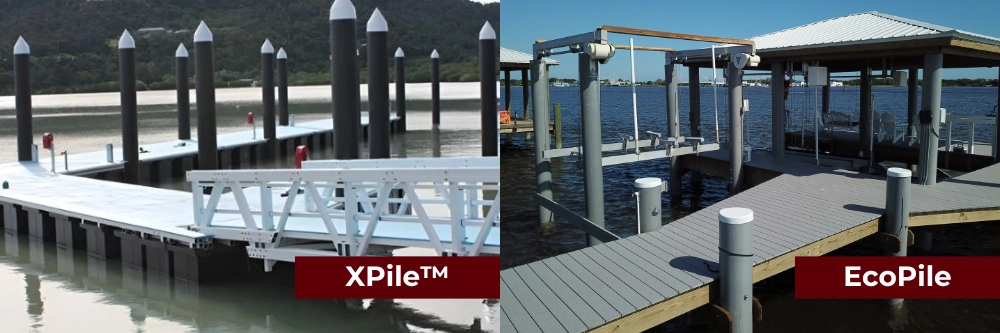
If you want certainty, the answer is straightforward: do not use wood where salt kill is a concern. Composite and fiberglass pilings have no wood fiber and no lignin, so there is nothing for salt crystals to separate. They simply cannot fail this way, the same way a concrete slab cannot get wood rot. For a coastal dock, pier, or bulkhead where you want the structure to last, that makes a non-wood piling the dependable choice. Our EcoPile® composite pilings and XPile™ FRP marine piles are both built for exactly this exposure. You can compare the full range on our marine and shoreline materials page.
None of this means wood is a bad material. For the right application, properly specified treated timber is proven and cost-effective. But where salt-killed wood pilings are the risk you are trying to eliminate, the only way to eliminate that risk is to remove the wood from the equation.
Environmental vs. biological deterioration: how to tell them apart
Salt kill and ordinary rot can look similar at a glance, but they are different problems with different answers. Read each row across to compare the two.
| What to check | Salt kill (environmental) | Rot (biological) |
|---|---|---|
| What drives it | Saltwater wicked up the wood, then dried by sun, leaving salt crystals | Living organisms: marine borers, fungi, termites |
| Where it shows | Sunny side, just above the waterline up to the deck line | At or below water, in damp trapped areas, or insect entry points |
| What it looks like | Fuzzy, stringy, brown fibers separating | Holes, soft punky wood, insect channels |
| Does treatment stop it | No. Oil-borne or sealing only slows it | Yes. Proper preservative treatment is designed to stop it |
| The certain fix | A non-wood piling (composite or fiberglass) | Correct treatment, retention, and detailing for the exposure |
Marine piling solutions for Houston and the Gulf Coast
On the Texas and Gulf Coast, constant saltwater and strong sun make salt-killed wood pilings a recurring problem for dock and bulkhead owners. Our team helps contractors and property owners across Houston, TX and the wider Gulf Coast choose materials that fit the exposure and the budget. When the goal is to take salt kill off the table entirely, we point people to composite. You can compare options on our EcoPile® composite pilings page, or read our comparison of the best wood for dock pilings. For projects that still call for wood, our guide to pressure treated pilings for marine construction walks through grades and retention.
Treatment standards still matter where wood is used. Industry guidance from the American Wood Protection Association and the Southern Pine Inspection Bureau sets the use categories and retention levels for marine exposure. For a project-specific recommendation, contact our project consultants and we will spec it with you.
Frequently asked questions about salt-killed wood pilings
What does salt-killed wood look like?
Salt-killed wood has a fuzzy, stringy, brown surface where the fibers have separated, usually on the sunny side just above the waterline. It comes from salt crystals growing inside the wood and breaking the lignin bond between fibers.
Can you repair salt-killed wood pilings?
There is no true repair once it starts. Coatings only slow it, because the wood keeps wicking saltwater underneath and the surface keeps deteriorating. The dependable answer is to replace the piling with a non-wood material.
Do salt-killed wood pilings come from marine borers?
No. Salt-killed wood pilings are caused by an environmental process, saltwater wicking up and drying in the sun, not by borers, rot, or termites. That is why standard biological preservative treatments do not prevent it.
Can salt kill be prevented?
Not with certainty on wood, and you cannot tell in advance which pilings will be affected. The only guaranteed way to prevent it is to use a composite or fiberglass piling that contains no wood.
Build it to last on the coast
Because you cannot identify in advance which wood piling will be affected by salt kill, the only dependable way to build for the long term on the coast is to use a product that cannot fail this way: a composite or fiberglass piling. Where wood is the right call for other reasons, oil-borne treatment and heavy sealing can extend its life, but they cannot promise to prevent salt kill. Tell us your project specs and our consultants will help you choose. Get a project estimate, or call us at (800) 716-0636.
Sources and references
- Johnson, Ibach & Baker, “Effect of salt water evaporation on tracheid separation from wood surfaces,” USDA Forest Products Laboratory, Forest Products Journal 42(7/8)
- Mississippi State University Extension, “What Is Salt Killed Wood?” Publication 2662
- American Wood Protection Association (AWPA), marine use categories and retention
- Southern Pine Inspection Bureau, Southern Yellow Pine treatment guidance